Why Everyone is Talking About MCP (And How It Connects Your AI to Company Data)

Gabriel Sorrentino
Founder · AI Solutions Architect, FluencerAI
5 min read
Have you ever tried using AI to analyze your company's data only to realize it seems to "live in a bubble"? No matter how powerful the model is (like Claude Opus), it generally doesn't have real-time access to your CRM, sales database, or internal documents unless you build complex and expensive integrations.
This is where the Model Context Protocol (MCP) comes in. Launched by Anthropic, this new standard is rapidly changing how companies think about AI implementation, solving the biggest current technological bottleneck: the barrier between the AI "brain" and practical business data.
What is MCP (Model Context Protocol)?
Think of MCP as the "USB-C of Artificial Intelligence". Previously, if you wanted an AI assistant to talk to Slack, Google Drive, and your SQL database, you had to build a custom integration for each one. If you switched AI models, you'd have to redo almost everything.
MCP is an open protocol that creates a common language. Now, companies can create a single "MCP server" for their data, and any compatible AI model can connect to it instantly.
Quick Answer: MCP allows AIs to access your local data and external systems (like GitHub, Postgres, or Salesforce) securely and in a standardized way, without the need for endless custom APIs.
Why MCP is a Game Changer for Your Operation
For leaders and decision-makers, interest in MCP isn't just technical; it's about ROI and scalability.
1. Ending the Integration Nightmare
Instead of spending weeks setting up integrations and APIs for every new AI project, MCP allows you to use pre-existing connectors. This reduces development time from months to days.
2. Real-Time Data (Without Hallucinations)
One of AI's biggest problems is "hallucination." When AI has direct access via MCP to your real, up-to-date data, response accuracy increases drastically. It doesn't have to "guess" inventory levels or customer status; it queries the source data directly.
3. Security and Governance
With MCP, your data doesn't need to be sent off to train third-party models. The AI "visits" your data through the protocol, processes the information, and delivers the result. You maintain total control over what the AI can or cannot see within your systems.
4. Flexibility (No Vendor Lock-in)
Since MCP is an open standard, your company isn't stuck with a single AI provider. If you use Anthropic today and want to migrate to an open-source model tomorrow, the data connection infrastructure (the MCP servers) remains the same.
Practical Use Cases in Your Company
How does this translate to daily operations? Here are some scenarios we are implementing at FluencerAI:
- Sales and CRM: An AI agent that queries Salesforce via MCP to prepare a personalized meeting summary, cross-referencing data from past Slack interactions and Zendesk support tickets.
- Software Engineering: AIs with direct access to your local repository context and technical documentation to suggest real-time bug fixes.
- Financial Analysis: Dashboards that query SQL databases directly to generate on-demand cash flow reports, without anyone needing to manually export CSVs.
How to start using MCP?
Adopting MCP does not require you to throw away what you already have. The ideal path is:
- Identify data silos: What information would be valuable for your teams if AI could access it?
- Implement MCP servers: Create or use existing connectors for those data sources.
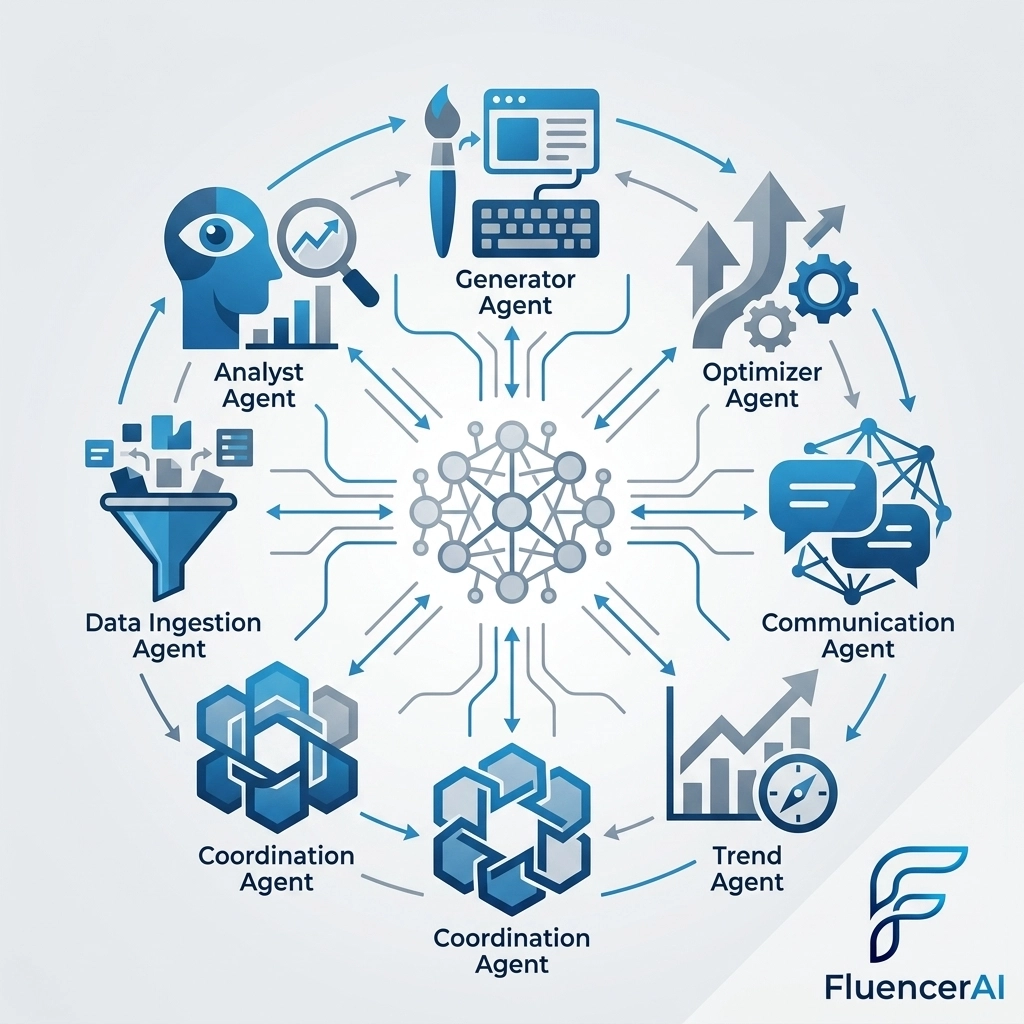
- Orchestrate agents: Configure AI agents that know how to use these connections to perform useful tasks.
At FluencerAI, we specialize in designing this architecture. We help companies move from the "generic chat" stage to a robust, connected process automation operation.
Frequently Asked Questions (FAQ)
Does MCP work with OpenAI (ChatGPT)?
Although it was launched by Anthropic, MCP is an open standard. Today, it is native to the Anthropic ecosystem (Claude), but the community is already building bridges so it can work with other models and development IDEs.
Does my company need a developer to configure MCP?
Yes, the initial setup of MCP servers and the integration with your legacy systems require technical knowledge in data architecture and APIs. That is where an AI consultancy makes a difference.
Does MCP replace RAG (Retrieval-Augmented Generation)?
No, they complement each other. RAG is great for retrieving information from static documents (PDFs, wikis). MCP is better for interacting with live systems and dynamic databases in real time.
Ready to connect your AI to what really matters?
The market is moving away from "AI as a chat" and towards AI as an operating system. MCP is the missing piece for this transition. If you want to stop copying and pasting data into AI and want it to work directly within your systems, we can help.
Schedule a diagnosis with FluencerAI and see how MCP can transform your operation.
About the Author
Related Articles
From Demo to Production: Why Infrastructure and Data Matter More Than the Model
You’ve seen this movie before: a company showcases an impressive AI agent demo. It answers complex questions, summarizes documents, and seems ready to revolutionize operations.
3 min read
7 Mistakes You're Making with AI Agent Implementation (and How to Fix Them)
You’ve likely heard that AI agents are the future of business productivity.
5 min read
Digital Genetic Code: Why 'Having AI' isn't the same as 'Being AI' in 2026
It is April 2026, and the Brazilian corporate landscape has just received a reality check.
4 min read
Ready to transform your business?
Schedule a free call and discover how AI can scale your operations.