The Architecture of Coding Agents: Why the "Harness" is the Brain of the Operation

Gabriel Sorrentino
Founder · AI Solutions Architect, FluencerAI
4 min read
Have you ever tried asking ChatGPT or Claude to build an entire system from scratch using only the chat window? If so, you know the experience starts out magical and ends in a chaos of "I forgot what we were doing" and "I can't see your files."
In 2026, the boundary between a "chatbot that can code" and a true Coding Agent has become crystal clear. The difference lies not just in the model (LLM) you use, but in what we call the Agentic Harness — the software scaffold that surrounds the model, giving it eyes, hands, and, most importantly, functional working memory.
At FluencerAI, where we build custom AI Agents for companies, we see that the secret isn't the engine, but the chassis. Let’s open the hood and understand why your next senior developer might actually be a well-designed orchestration loop.
What, Exactly, is the "Harness"?
Imagine the LLM (like GPT-5.X or Claude Opus) is a high-powered Formula 1 engine. If you put that engine on the ground and turn it on, it will make a lot of noise but go nowhere. The Harness is everything else: the chassis, the wheels, the steering wheel, the sensors, and the telemetry system.
While a simple chat is reactive, an agent operating within a harness is proactive. It doesn't just suggest code; it navigates your repository, reads documents, runs tests, and decides the next step based on the error it just received in the terminal.
The 6 Pillars of an Elite Coding Agent Architecture
For a coding agent to be productive on an industrial scale, it needs six fundamental integrated components.
1. Live Repository Context (Workspace Context)
An agent cannot work in a vacuum. Before starting, the harness maps the terrain. It identifies the current branch, reads the README.md, understands the folder structure, and knows where the tests are located. At FluencerAI, we focus on creating this AI Development with "situational awareness".
2. Prompt Shaping and Cache Reuse
In 2026, no one sends the entire history in every message anymore — it's expensive and slow. Modern harnesses use Prompt Caching. The "how to be a good coder" instructions and tool descriptions stay fixed in the cache, while only the new task and recent changes are processed. This drastically reduces latency and operational costs.
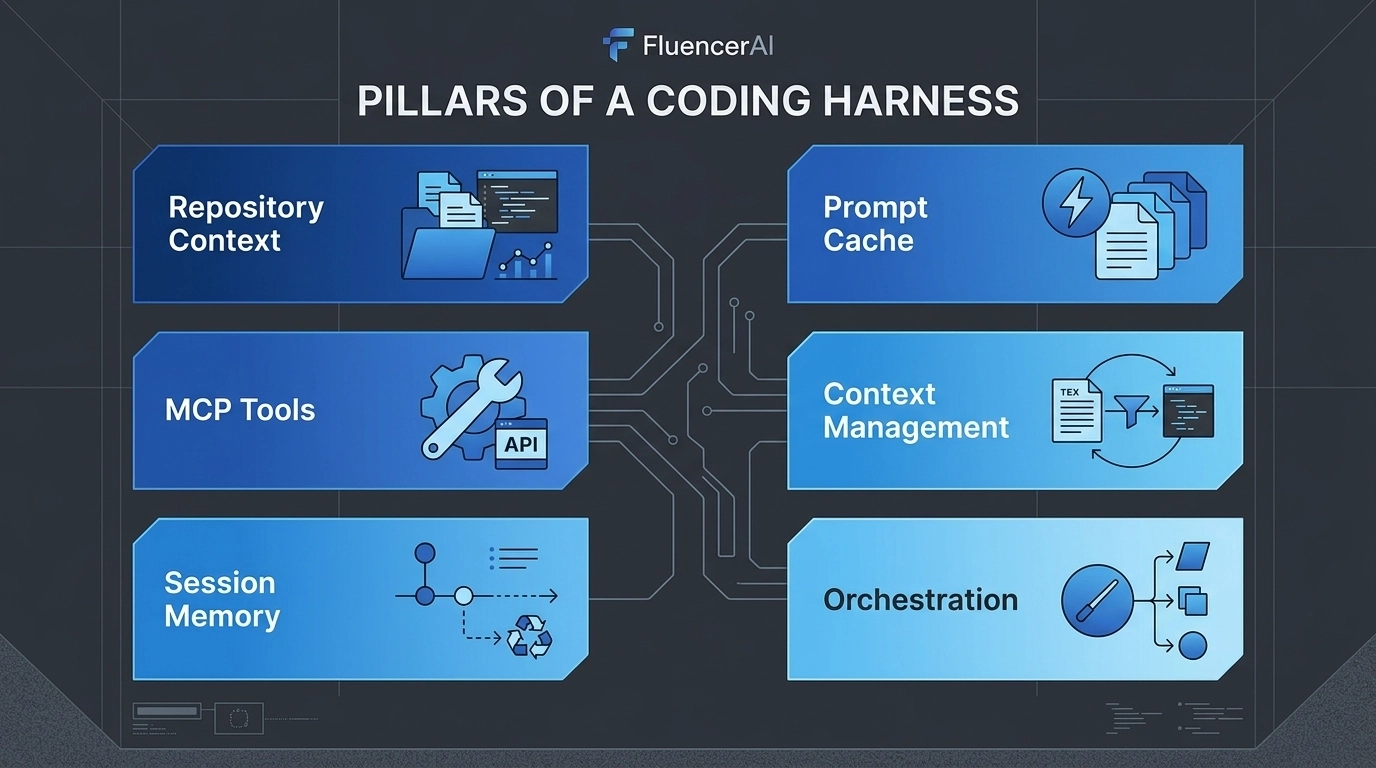
3. Structured Tools and the MCP Protocol
The major recent revolution is the Model Context Protocol (MCP). The harness doesn't let the agent "improvise" commands. It exposes specific tools: list_files, read_file, execute_test, search_codebase. The agent sends a structured request (JSON), the harness validates it, asks for permission if necessary, executes it, and returns the result. It’s the end of dangerous terminal commands running unsupervised.
4. Context Management and Noise Reduction
Information overload is the enemy of intelligence. If the agent reads a 10,000-line error log, it gets lost. The smart harness applies clipping and deduplication. It summarizes long outputs and ensures the "token budget" is spent on what truly matters for solving the current problem.
5. Structured Session Memory
Unlike a chat, the agent has a Working Memory and an Event Log.
- Event Log: The complete, raw history of everything that happened (useful for auditing).
- Working Memory: A distilled summary of what has been done, what remains to be done, and which files are currently crucial.
6. Delegation and Sub-agents (Multi-Agent Orchestration)
A single agent trying to do everything gets overwhelmed. The trend now is orchestration. The "Master Agent" can create an "Analyst Sub-agent" just to read the documentation for a new API, while another sub-agent focuses on writing unit tests.

How FluencerAI Turns This into Real ROI
Many companies try to "do AI" on their own and end up with tools that no one uses because they aren't reliable. Our AI First Business approach focuses on implementing these harnesses strategically.
Whether through our CTO On Demand service, where we design the technological architecture of your startup, or through the creation of custom AI Agents for internal process automation, we ensure that AI isn't just a toy, but a productivity gear.
You can see real examples of how these orchestrations work in our Showroom.
Ready to scale your engineering with AI?
The era of "manual" programming is being replaced by the era of orchestrating intelligent systems. If you want to understand how to apply this architecture to your business, let's talk.
Schedule a diagnosis with FluencerAI and discover how we can accelerate your production with agents that actually deliver.
Frequently Asked Questions
- What is the difference between an Agent and Copilot?
- Copilot is an "autocomplete" assistant. An Agent is a "task executor." Copilot suggests the line; the Agent resolves the entire support ticket in Jira. Is it safe to let an agent run commands on my code? Yes, as long as the Harness has human approval layers and sandboxing. At FluencerAI, we implement security protocols where the agent only executes critical changes after your validation. How much does it cost to maintain such an architecture? With the use of Prompt Caching and optimized models, costs have dropped 80% in the last two years. The return on investment (ROI) comes from delivery speed: what used to take 2 weeks now takes 2 hours. Does my company need to be a tech company to use this? On the contrary. Logistics, retail, and finance companies gain the most by automating legacy processes with agents that understand code that no one else wants to touch.
About the Author
Related Articles
How AI Is Redesigning the Pact Between 5 Generations at Work
!Five generations linked by digital bridges and a central AI orchestration layer in an executive geometric composition Five generations working together would already be complex on its own.
5 min read
Global Leadership: How to Manage Remote Teams Without Losing Your Sanity (and Profit)
!heroImage If you still get that uneasy feeling when you think about your lead developer being in Berlin, your designer in Curitiba, and you trying to orchestrate everything from
5 min read

On-Demand CTO: The Survival Guide for Modern Tech Leadership
!Executive technology leadership environment with abstract dashboards and FluencerAI branding The image of a CTO who spends the entire day "bit-shoveling" and reviewing every line
5 min read
Ready to transform your business?
Schedule a free call and discover how AI can scale your operations.