
10 Reasons Why Your Process Automation Isn't Delivering ROI (and How to Fix It)

Gabriel Sorrentino
Founder · AI Solutions Architect, FluencerAI
5 min read
You decided to invest in technology to scale your operations. You bought tools, hired licenses, and automated workflows. However, six months later, it feels like nothing has changed: errors persist, the team is still overwhelmed, and the return on investment (ROI) is invisible.
If this sounds familiar, you’re not alone. The reality is that most companies automate chaos, expecting technology to organize it. The result? Faster, more expensive chaos.
In this article, we’ll get straight to the point. No hype, no unnecessary jargon. We will identify the 10 reasons why your automation is failing and, more importantly, how you can correct course to turn operational efficiency into real profit.
Executive Summary: Why Does Automation Fail?
For those in a hurry, the problem usually isn't the tool, but the strategy. Automation fails when:
- It automates bad processes (accelerated inefficiency).
- It lacks clear metrics (blind ROI).
- It fails to integrate systems (data islands).
- It focuses on isolated tasks instead of the full workflow.
- It ignores maintenance and the human factor.
1. Automating a Process That Is Already Bad
The number one mistake is what we call "paving the cow path." If a manual process is confusing and full of bottlenecks, automating it will only make those errors instantaneous.
- The Solution: Before any line of code or configuration, perform a critical mapping. Simplify the flow, eliminate redundant steps, and only then automate what remains.
2. Lack of KPIs and ROI Tracking
How do you know automation worked? "It feels like we're faster" is not a business metric. Without KPIs defined before implementation, it’s impossible to measure success.
- The Solution: Define clear metrics: reduction in man-hours, decrease in error rates, increased customer response speed. Use dashboards to monitor this data in real-time.
3. Prioritizing the Tool Over the Strategy
Many companies buy the latest software before understanding the problem. This leads to spending on unnecessary licenses and tools that don't talk to the rest of the operation.
- The Solution: Start with the business problem. The tool should be the last decision, chosen based on your current technical stack and long-term goals.
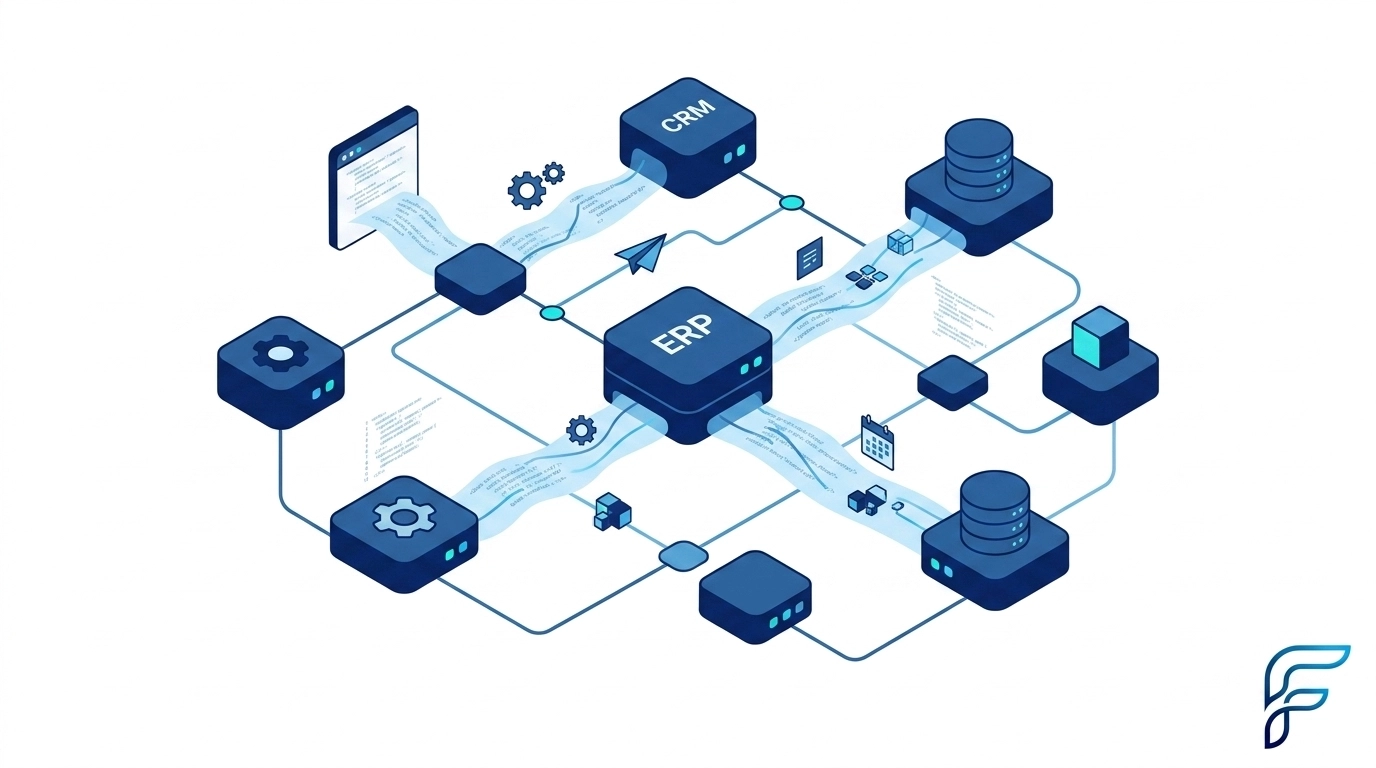
4. Systems That Don't Talk (Lack of Integration)
If your sales bot doesn't talk to your CRM, and the CRM doesn't talk to the financial ERP, you've only created new silos. The manual work of transferring data between tools still exists, now disguised.
- The Solution: Invest in robust APIs and integrations. Automation only generates real ROI when data flows frictionlessly across the entire customer journey.
5. Focusing on Tasks, Not End-to-End Flows
Automating the sending of an email is easy. The challenge is automating lead qualification, scheduling on the salesperson's calendar, and proposal creation. Focusing on small tasks generates marginal gains.
- The Solution: Look at the full flow. Use AI agents that can make simple decisions and orchestrate complex processes instead of simple "if this, do that" scripts.
6. Ignoring the "Human-in-the-loop" (Exceptions)
No system is 100% fail-proof. When automation encounters an unforeseen situation, it crashes or generates a major error. If there isn't a human ready to intervene, the process dies.
- The Solution: Develop exception handling flows. Automation should take care of the repetitive 80% but must have clear mechanisms to escalate the complex 20% to the human team.
7. Cultural Resistance and Lack of Training
Brilliant automation is useless if your team is afraid of being replaced or doesn't understand how to use the new tool. The result is "Shadow IT": people going back to using hidden side spreadsheets.
- The Solution: Involve the team in the solution design. Show that AI and automation are there to remove tedious work and free up time for strategic work.
8. Poor Quality Data (Garbage In, Garbage Out)
Automation based on wrong, duplicated, or outdated data is a recipe for disaster. If the database is bad, the automation output will be equally useless.
- The Solution: Clean your data before automating. Establish governance rules to ensure that the information feeding your bots is reliable.
9. Lack of Maintenance and Governance
Processes change. Third-party APIs update. If you "set and forget," your automation will break in a few months.
- The Solution: Treat automation as a living asset. Establish a technical maintenance and process review routine to ensure the solution stays aligned with company goals.

10. Absence of Strategic Technical Leadership
Often, the automation project is "tossed" between Marketing and IT, without an owner who understands both business and technology. This leads to poor technical decisions that generate technical debt.
- The Solution: If your company lacks a technology leader focused on innovation, consider a fractional CTO. Having a strategic vision in the solution architecture saves thousands of dollars in rework.
How long does it take to see a financial return on automation?
Generally, well-planned automations in critical areas (sales, support, or finance) show a positive return within 3 to 6 months.
Should I automate everything at once?
Definitely not. The ideal is to start with an MVP (Minimum Viable Product) focused on the process that consumes the most time and generates the least value today. Validate, reap the ROI, and expand.
Is process automation the same as AI?
No. Traditional process automation follows fixed rules. AI (and AI Agents) adds a layer of intelligence and decision-making, allowing for the handling of unstructured data and process variations.
Transform Your Operation with FluencerAI
If you feel your company is stagnant in manual processes or if you've already tried to automate and saw no results, perhaps what’s missing is the right execution partner.
At FluencerAI, we don't just deliver tools; we design the AI and automation strategy that makes sense for your balance sheet. Whether through a complete diagnosis, the implementation of intelligent agents, or the support of a fractional CTO, we are here to ensure your technology generates profit, not just costs.
About the Author
Related Articles

HumanX 2026: Why Speed Without Method is the Recipe for AI Chaos
!HumanX 2026 Hero If you’ve been following the behind-the-scenes of HumanX 2026 in San Francisco, you’ve felt a clear shift in the air.
5 min read

The Architecture of Coding Agents: Why the "Harness" is the Brain of the Operation
!Coding Agent Architecture Have you ever tried asking ChatGPT or Claude to build an entire system from scratch using only the chat window?
4 min read

Digital Genetic Code: Why 'Having AI' isn't the same as 'Being AI' in 2026
It is April 2026, and the Brazilian corporate landscape has just received a reality check.
4 min read
Ready to transform your business?
Schedule a free call and discover how AI can scale your operations.